
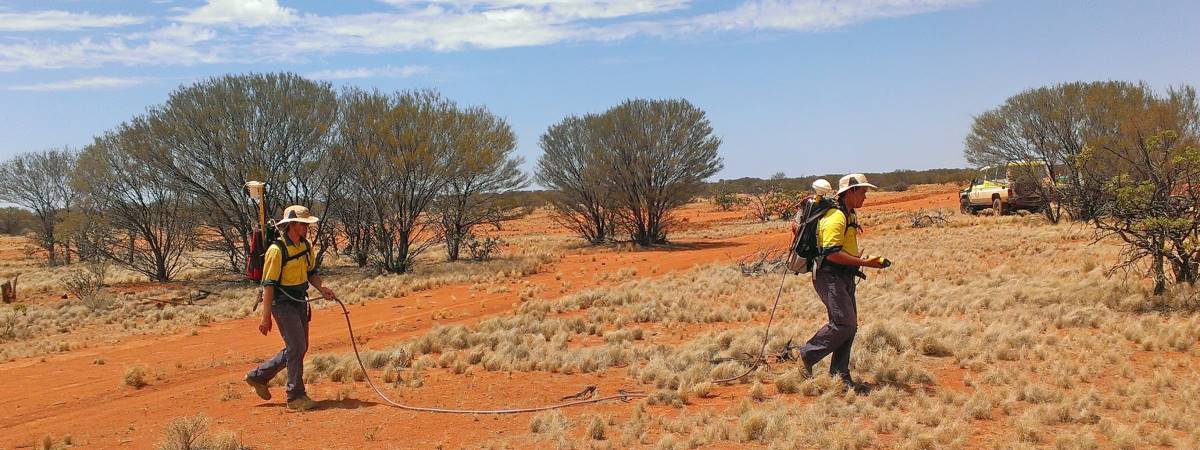
What is Sub-Audio Magnetics?
Sub-Audio Magnetics (SAM) is a proprietary survey technique which requires a geophysical transmitter to transmit a precisely controlled signal into either an inductive transmit loop or a grounded dipole in order to induce secondary fields in sub-surface conductors. Using Gap GeoPak transmitters, currents of up to 200A are normally achieved with low resistance loops. Typically, 15-30A will be transmitted into a grounded dipole.
A Gap Geophysics TM-7 SAM Receiver is used to record the earth’s total magnetic field at sample rates up to 9600Hz. The TM-7 uses a caesium vapour magnetometer sensor which provides a scalar total field measurement without the requirement of levelling or orienting the sensor.
The acquired data is post-processed to extract several parameters which relate to different physical properties of the earth. The actual parameters available are dependent on the survey configuration and may include:
- Total Field MagnetoMetric Conductivity (TFMMC)
- Total Field ElectroMagnetics (TFEM)
- Total Field MagnetoMetric Induced Polarisation (TFMMIP)
- Total Magnetic Intensity (TMI)
Each parameter extracted from a different part of the received waveform. TFMMC is an ON-time measurement as it occurs whilst current is being transmitted into the dipole where as TFEM and TFMMIP are OFF-time measurements as they occur whilst the transmitter is switched off. TMI is recovered from the low frequency component of the waveform.
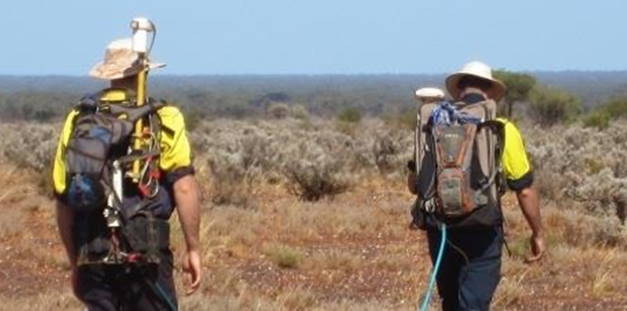
SAM Magnetometric Conductivity (MMC) mode
In this survey layout, a galvanic loop is used to inject current directly into the ground, which enables SAM to deliver high definition Total Magnetic Intensity and Magnetometric Conductivity data sets.
This type of survey better suits the detection of faults, fractures, and other geology that is detected by seeking resistive anomalies in conductive terrain.
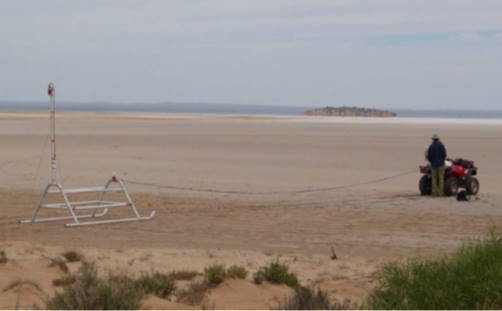
SAM Fixed Loop Electromagnetics (FLEM) mode
In fixed loop mode, a high powered transmitter will send current through a closed loop, inducing a secondary field in the ground. SAM-FLEM delivers Total Magnetic Intensity, Total Field Electromagnetics and derived 3-component Electromagnetic data from one survey.
This technique is able to detect large conductors (such as massive sulphides) under far greater depth of cover than possible with conventional EM methods.
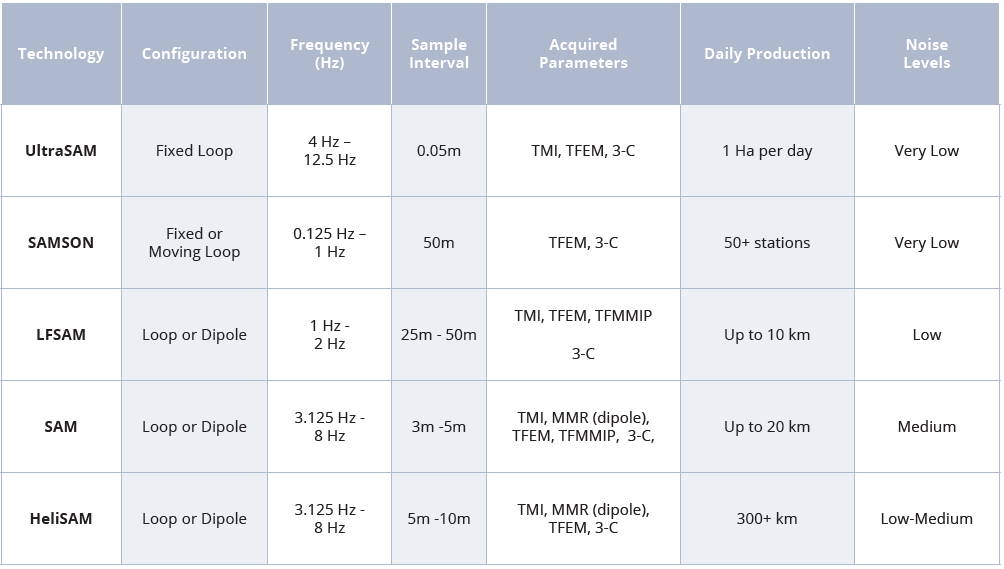
SAM B-Field Technologies
Gap Geophysics has developed specialisations of the SAM technology for different applications and scenarios. These are summarised in the following table.
Contact Gap Geophysics for further information and find out how we can help you with your next discovery.
SAM Successes
SAM has been the primary discovery technology for many significant finds. Various reports on successes are available (below) and many recent news articles have been demonstrating the capabilities of the technique. Please contact us for any further information.